What does the hash in a Nix store path actually name?
Store Paths, the second Part of LabCraft's Nix course, is now available. It uses a real NixOS machine to answer what names a path and why that name moves.
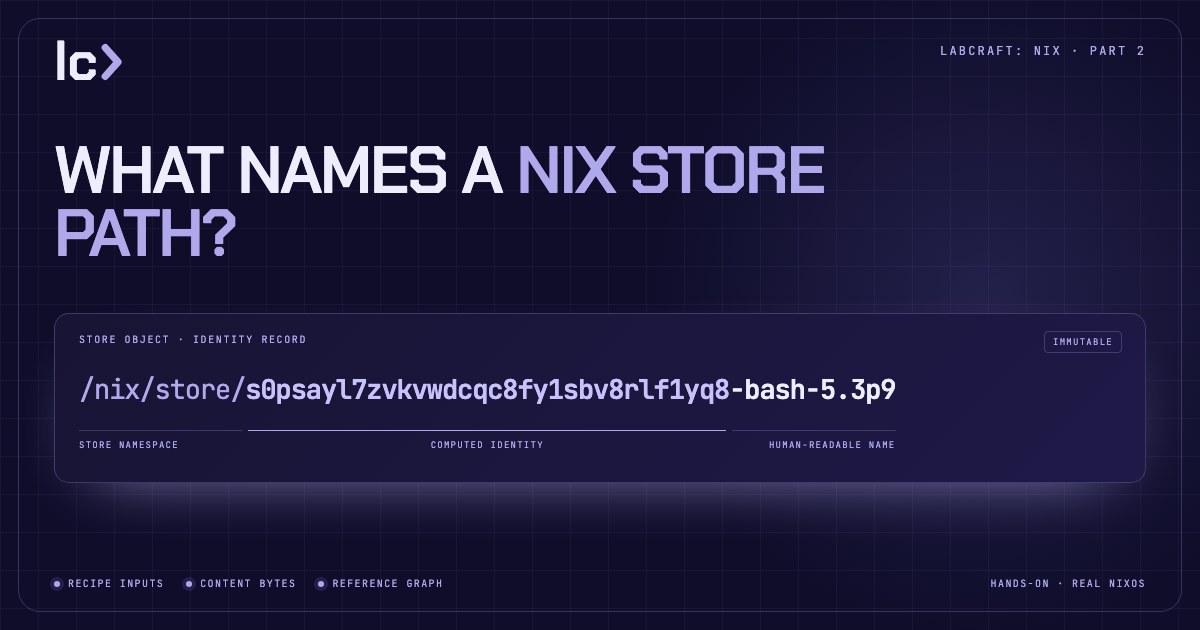
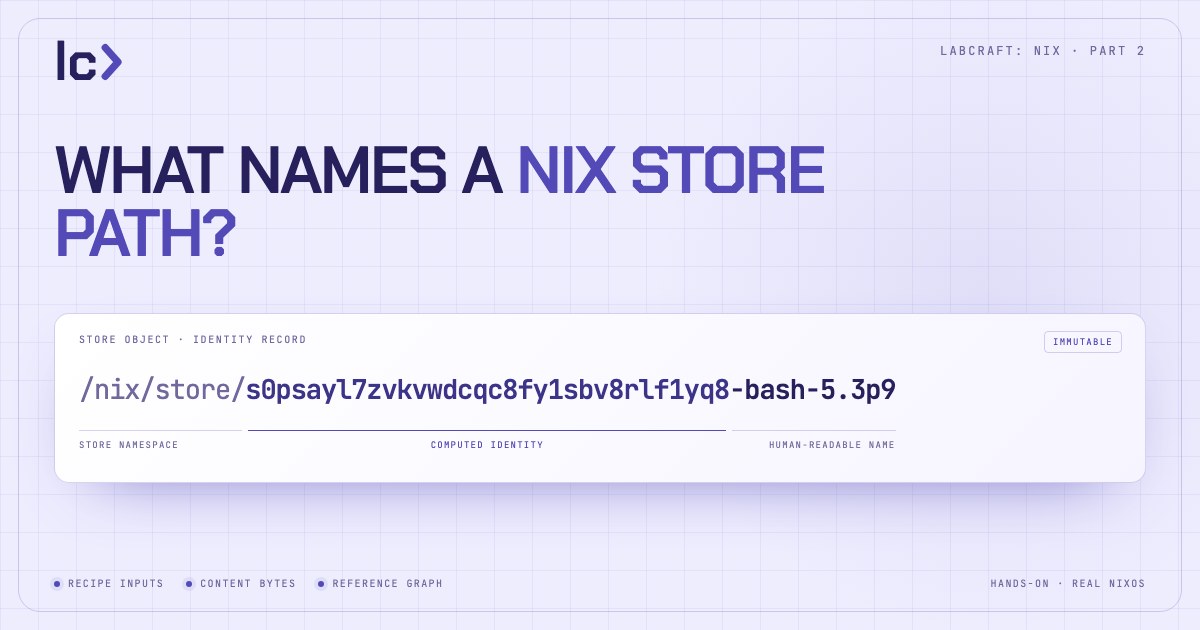
A Nix store path looks like this:
/nix/store/s0psayl7zvkvwdcqc8fy1sbv8rlf1yq8-bash-5.3p9
The last bit is friendly. This one contains Bash 5.3p9. The 32 characters before it are harder to explain.
“The hash comes from the inputs” is a common answer. It is also incomplete. Is Nix hashing the file you wrote, the build recipe it evaluates to, the bytes produced by the build, or the packages it depends on?
There is not one naming rule behind every store path.
Most package paths are named from the recipe
For a normal package build, the .nix file is a description. Nix evaluates that
description into a derivation, which is the concrete build recipe. The recipe
names the builder, arguments, environment, declared outputs, and dependencies
that Nix will use.
That gives Nix enough information to determine an input-addressed output path before the build runs. The finished bytes do not need to exist yet.
This is why editing a Nix expression does not always produce a new path. Two expressions can evaluate to the same recipe. It is also why an edit that changes an actual recipe input produces a different identity. Nix names what it will build, not the spelling of the expression that described it.
Some paths are named from their contents
Nix can also name a store object from bytes it already has. nix store add is a
simple example. Here the content exists first, so Nix can hash it directly. The
path is content-addressed.
Both kinds of path live under /nix/store. Calling every store path
“content-addressed” misses the distinction. For one, the build plan determines
the identity before an output exists. For the other, the content supplies the
identity.
That distinction makes several bits of Nix behavior less mysterious. It helps you predict whether a change should move a path, understand why an old result can remain beside a new one, and reason about what a cache can safely reuse.
The name is only part of the record
A store path rarely works alone. Built paths contain references to other store paths, and Nix records those references as a graph. Follow the graph from one path and you get its closure: everything that must travel with it to another machine.
The same record lets Nix explain why a dependency is present and check whether the bytes on disk still match what it recorded. Store paths are not opaque directory names. They are identities inside a database Nix can query.
Why this became Part 2
First Contact was deliberately about a new learner's first session with Nix: install it, see the store, use packages without adding them to the host, declare a script's dependencies, and remove the installation cleanly.
Store Paths goes underneath that command-line introduction. It runs on a real NixOS machine because the operating system itself is the largest store object a learner can inspect. It does not require the Nix language. The example expressions are staged so the learner can focus on reading what Nix produced.
The five labs put four questions in front of the learner:
- What on the running system resolves into
/nix/store? - Which changes affect recipe identity?
- When is a path named from a recipe, and when is it named from bytes?
- How do references, closures, and integrity fit into the same model?
Start the Nix course. See what you predict before the machine gives you the answer.